


Every company is rebuilding how work gets done around AI. Spend is going up, and so is adoption. But most AI dashboards still report the same things: active users, seats, prompts sent. Those numbers show that people use AI. They don't show which business processes are getting better, where work is stuck, or what to change next.
That's the question leaders accountable for AI now have to answer. In McKinsey's State of AI 2026, 80% of respondents say AI has made them more productive, but only 37% see any business impact. Individual gains don't add up to company gains on their own. AI Transformation leaders need to understand AI work, find what's working, scale it.
Today we're introducing AI Workflows in Lanai.
From AI activity to an action plan
Lanai's proprietary models discover AI Workflows automatically from AI activity across any AI tool. No tagging, surveys or interviews. Then it runs an improvement loop:
- What work is AI doing? Lanai maps each workflow in phases, with AI leverage, tools and spend for each, so you can see where AI does the work and where it doesn't.
- Where should we improve? See where AI creates leverage, where work gets stuck, and where spend isn't paying off.
- What should we change? Lanai recommends the next move for each workflow, with its estimated impact and the business goal it serves: a skill or agent built from how your best people already work, coaching that spreads their tactics, or a cost change like routing simpler work to a lighter model or consolidating overlapping tools.
- Did it work? Track whether the change improved leverage, moved business outcomes, or optimized costs for the value gained.
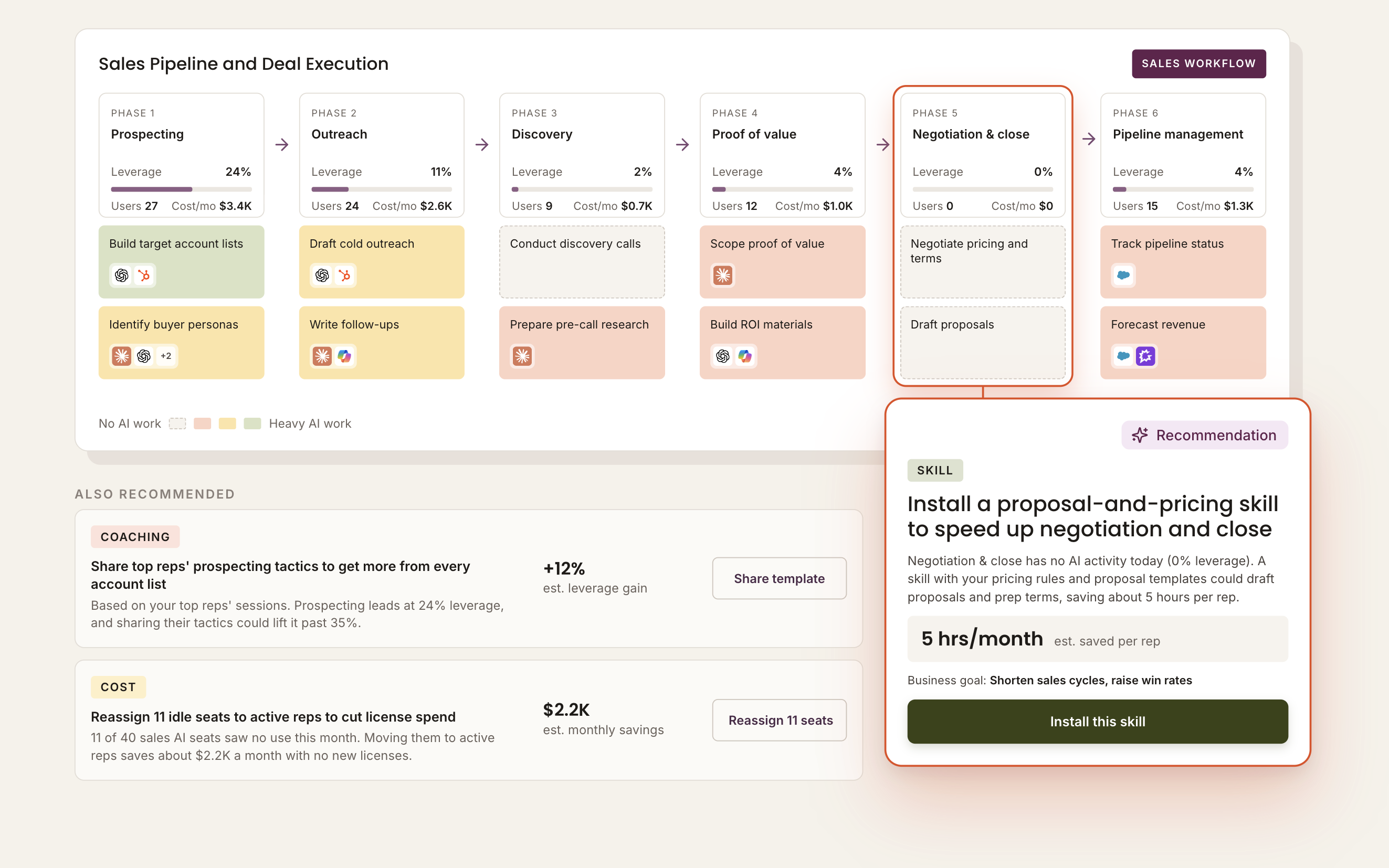
What it looks like in enterprises across verticals:
The same loop works across verticals. Four examples of customers benefiting from it:
- Sales at a publicly traded Enterprise SaaS Co. Lanai mapped the sales funnel workflow and found top 10% reps getting 3–5× more out of AI than the average rep, and recommended turning their habits into shared team skills. Lifting the average rep's AI use by a quarter is estimated to return about 1.5 hours per rep each week.
- Engineering at a compliance software company. Lanai mapped each step of how its software gets built and shipped, and recommended an AI merge skill to review code changes before they ship. In a typical engineering team, a recommendation like this is estimated to return about 6 hours per engineer each month.
- Legal practice at a law firm. Lanai found several AI tools doing the same legal work, ahead of about $1.5 million in renewals. Partners used the overlap to decide which tools to keep and where to train attorneys to get more out of AI agents.
- Campaign management at a retail brand. Lanai found routine work running on the most expensive AI models. The team limited who could use them, moved that work to cheaper models and updated its AI training. Moving routine work like this to lighter models has typically cut spend by 15% ($185k annually in this case) without degrading work quality.
Real-world customer stories
CivicPlus used Lanai's cross-tool evidence to guide a vendor migration and bring AI work into its 2027 goals.
"Lanai found multiple AI solutions for responding to RFPs. It helped us decide what to standardize and gave us a way to turn that work, and dozens of other workflows, into company-wide goals." — SVP, AI Enablement & Delivery, CivicPlus
Xactly's leaders use Lanai to produce executive reporting, department drill-downs and recommendations for quick wins.
"We have an enterprise-wide ROI report with Lanai with next steps on training, skills/agents and cost efficiency. Lanai is the lynchpin and central to our journey on becoming AI-Native in 2027." — CHRO, Xactly
Cority's leaders use Lanai's insights for engineering upskilling, BDR skills, team coaching and board reporting.
"I've been chasing this kind of SDLC data for my entire career. We're using Lanai to upskill our teams, execute on automation opportunities and report our progress in our board meetings." — CTO, Cority
Start with one workflow
If you're setting 2027 AI budgets and goals, you're probably being asked some version of the same question: what is all this AI spend actually changing, and where should we invest next? You don't need another dashboard to answer it. Pick the workflow that matters most to your business, and we'll show you where AI is doing the work today, what to change first, and what it's worth.